
Date: 29.10.2026
On 28 October 2026, Domestic Trade and Cost of Living Minister Datuk Armizan Mohd Ali was reportedly saying that the Malaysia Competition Commission (MyCC) issued proposed decisions against 18 enterprises on 13 October 2026 over suspected bid rigging in 30 government tenders for food supply and cleaning services worth RM108.3 million.
The latest proposed decision by MyCC
The Minister of Domestic Trade and Cost of Living, Datuk Armizan Mohd Ali, disclosed MyCC’s proposed decision in the Dewan Rakyat on 28 October 2026. The key facts reported so far:
| Item | Detail |
| Date of proposed decisions | 13 October 2026 |
| Enterprises | 18 |
| Tenders | 30, for food supply (including cooked meals for schools and public universities) and cleaning services |
| Total procurement value | RM108.3 million |
| Procuring entities | 12: six ministries, three public universities, two state Islamic religious departments, one federal statutory body |
| Evidence cited | Centralised coordination and preparation of tender documents; exchange of information, including proposed bid prices; sharing of financial and human resources |
| Next step | Enterprises may make written and oral representations before MyCC issues its final decision |
The 18 enterprises in question have not been publicly named. It should be noted that a proposed decision is a preliminary finding. A proposed decision is not considered by MyCC a conclusive determination that the Competition Act 2010 has been infringed.
What is bid rigging?
In simple terms, bid rigging is when bidders who should be competing agree, openly or tacitly, on who will win a tender or at what price. Under Section 4(2)(d) of the Competition Act 2010, an agreement between enterprises with the object of bid rigging is deemed to significantly prevent, restrict or distort competition.
The agreement need not be written. A phone call, a WhatsApp message, may be considered by MyCC as evidencing a bid rigging agreement. There are four common forms of bid rigging:
| Type | How it works | Red flags |
| Cover bidding | A bidder submits a deliberately high or non-compliant bid so a pre-agreed winner looks competitive | Losing bids with identical typo errors, formatting or handwriting |
| Bid suppression | A bidder agrees not to bid, or withdraws, so another can win | Fewer bidders than expected; a regular bidder suddenly absent |
| Bid rotation | Bidders take turns to win across a series of tenders | Winners follow a pattern by period, agency or region |
| Market allocation | Bidders divide customers or areas and do not compete within each other’s share | The same firm always wins at one agency or in one state |
These often come with a pay-off: a subcontract, a cash “compensation” fee or shared profits for the losing bidders.
Using the same agent, consultant or tender preparer as a competitor is not automatically unlawful under the Competition Act 2010. However, care should be exercised where a common tender or bid agent or consultant is used and the agent or contractor has access to confidential information of more than 1 bidder. Our earlier article discussed when does engaging a 3rd party agent or consultant in a tender process give rise to a risk of infringing Malaysia Competition Act 2010 can be read https://www.wenlaw.co/legitimate-tender-support-or-bid-rigging-when-does-engaging-a-3rd-party-agent-or-consultant-in-a-tender-process-give-rise-to-a-risk-of-infringing-malaysia-competition-act-2010/
How a MyCC investigation works, and what to do
Generally, a MyCC case moves through six stages, and the options open to an alleged infringing enterprise narrow at each one. The right step depends largely on where you are at the investigation stages.
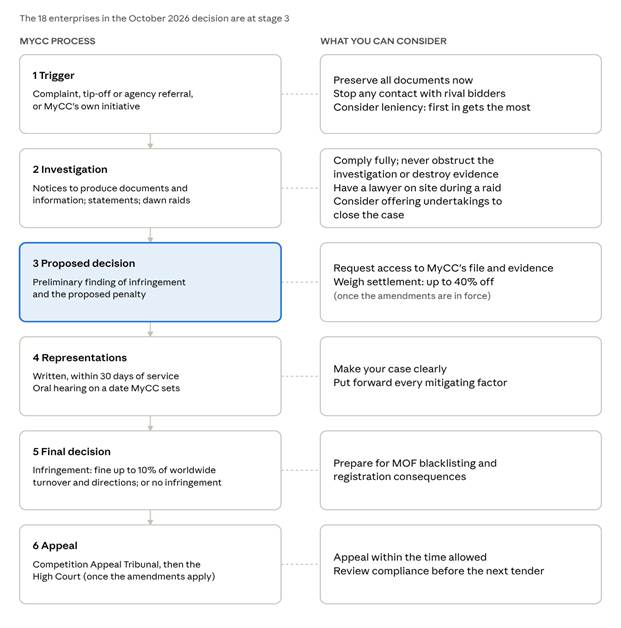
Two routes can sharply reduce financial penalty exposure. Leniency under section 41 of the Competition Act 2010 rewards the first enterprise to come forward with a reduction of up to 100% of the penalty. Undertakings under section 43 can close a case without a finding. Once the Competition (Amendment) Act 2026 come into force, undertaking is required by MyCC to be offered before a proposed decision is issued by MyCC. However, both options ought to be assessed carefully as there may be other repercussions to be take into account.
During the investigation, MyCC can require documents and information, record statements, and search premises with or without a court warrant. Obstructing an investigation, or giving false or misleading information and tipping off, is itself an offence under the Competition Act 2010.
The amendments to Competition Act 2010
The Competition (Amendment) Act 2026 and the Competition Commission (Amendment) Act 2026 passed the Dewan Rakyat on 6 July 2026 and the Dewan Negara on 27 July 2026. Both Acts were gazetted on 23 October 2026. The amendments will only come into force on a date the Minister appoints by notification in the Gazette.
Once in force, enterprises under investigation will have more options, and face more risks, than today:
| Change | What it means for alleged infringing enterprise |
| Settlement | After a proposed decision, an enterprise that admits liability may settle for a penalty reduction of up to 40% |
| Undertakings | Undertakings to close a case must be offered before a proposed decision; breach or misleading information may allow MyCC reopen the case |
| Wider cartel rule | The deeming provision no longer expressly provides a horizontal agreement, so arrangements with agents or suppliers may also be caught under s. 4(2) of the Competition Act |
| Stronger powers | MyCC can compel information (including from government bodies), run preliminary inquiries, impose interim measures and reopen investigations if new facts emerge |
| Obstruction | Attempting to destroy, conceal or alter records becomes an offence |
| Whistleblowers | New protection for informers, and MyCC may pay rewards |
| Appeals | Competition Appeal Tribunal decisions can be appealed to the High Court, by either the infringing enterprise or MyCC |
Hence, if an enterprise is already under an investigation by MyCC, timing matters. Whether to offer undertakings, seek leniency or wait for a settlement window is a strategic choice best considered and made early. Our earlier article discussing some of the enhanced and new enforcement tools by MyCC, e.g. settlement procedures, undertakings and leniency can be read at https://www.wenlaw.co/competition-law-in-malaysia-after-amendment-bills-2026-from-legal-awareness-to-enforcement-readiness/
Future in government procurement after an infringement finding by MyCC
Under Section 40 of the Competition Act 2010, an enterprise can be fined up to 10% of its worldwide turnover over the infringement period. For a business that lives on public contracts, the procurement consequences can be far more serious than paying a financial penalty.
- Five-year blacklisting. Under the MOF circular on Integrity in Public Procurement (PK 1.6), in force since 1 June 2022, individuals or companies found involved in bid rigging in public procurement face a five-year blacklist.
- MOF registration. Registration can be suspended or cancelled, which shuts you out of tenders that require it.
- The Government Procurement Act. Once in force (expected 2027), an application for registration must be refused, and an existing registration may be suspended, where the supplier is named in a MyCC infringement finding. Read our previous article on Malaysia’s Government Procurement Act: What Businesses Need to Know at https://www.wenlaw.co/malaysias-government-procurement-act-what-businesses-need-to-know/
- Wider fallout. Reputational damage, termination rights in existing contracts and possible follow-on claims by procuring entities. Section 64(1) of the Competition Act 2010, any person who suffers loss or damage directly as a result of an infringement of any prohibition under Part II shall have a right of action for relief in civil proceedings in a court under this section against any enterprise which is or which has at the material time been a party to such infringement.
This update is for general information only and does not constitute legal advice. Specific legal advice should be sought for any particular facts or situation.